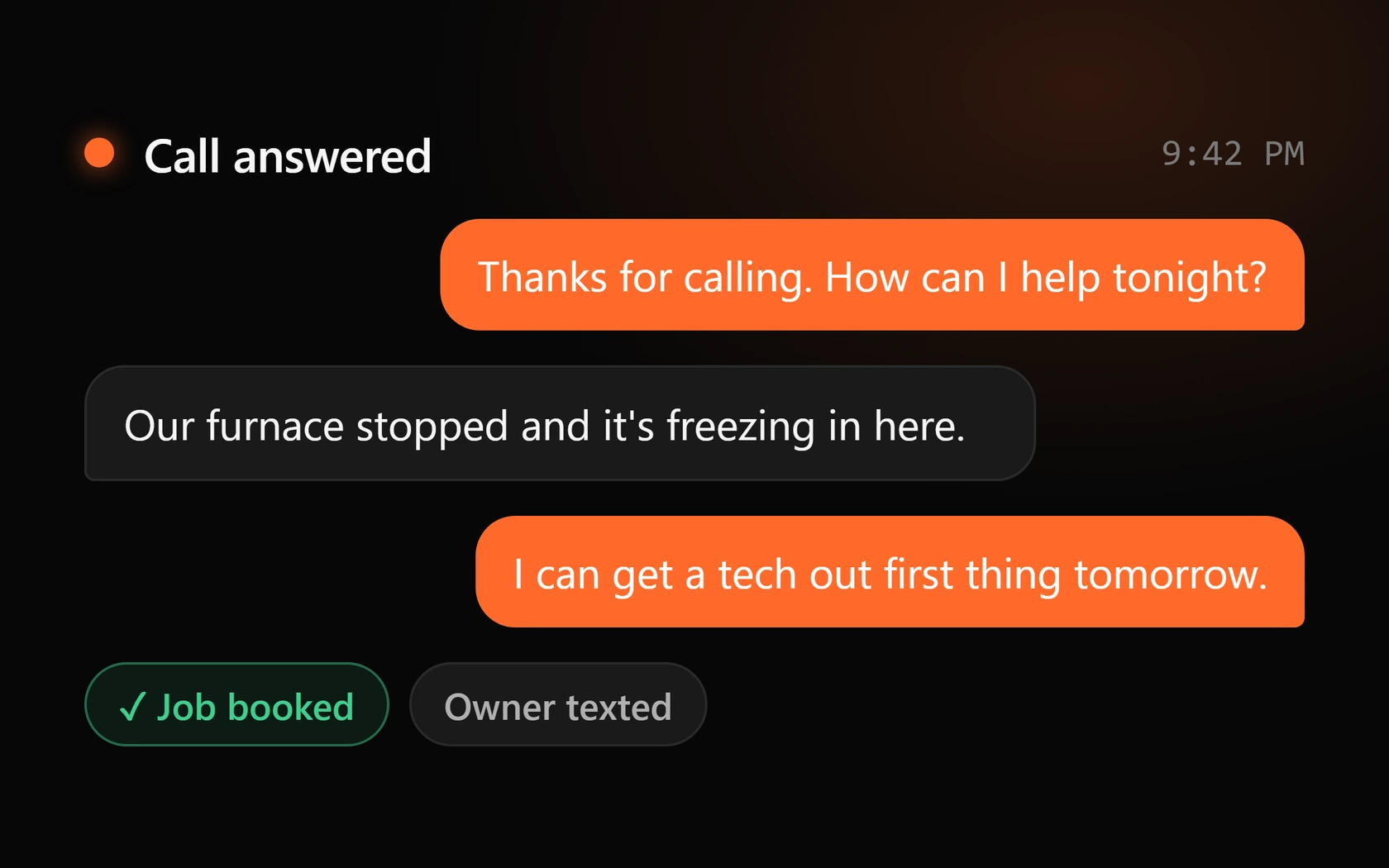
Every owner knows missed calls cost money. Few know how much. You do not need an industry statistic to find out. You need four numbers from your own business and about ten minutes.
Below is the formula, how to pull each number, worked examples for three trades, and a follow-up schedule for estimates that go quiet.
The formula
- Missed leads per month = inbound leads per month × share you miss or answer too slowly
- Lost leads = missed leads × share who never reconnect with you
- Lost jobs = lost leads × your close rate
- Lost revenue per month = lost jobs × your average job value
Multiply by 12 for the year. If you want lost profit instead of lost revenue, multiply by your gross margin.
Where to get your four numbers
Inbound leads per month
Pull your call log from your phone carrier or phone system for the last three months. Count unique numbers, not total calls. Take out spam, vendors and existing customers calling about scheduled work. Add form fills, Google messages and texts from new customers. Divide by three.
Share missed or slow
From the same log, count new-customer calls that went unanswered or to voicemail. For forms and messages, count the ones where the first real reply took longer than your own target. Pick that target yourself. For a service call, I would use the same business day.
Share who never reconnect
This is the hardest number and the most honest one. Take the missed numbers from last month and check how many later became a booked appointment or an invoice. The rest never reconnected. If you cannot check, use a range like 30% to 70% and see how much the answer moves.
Close rate and average job value
Close rate is jobs sold divided by leads you actually spoke to (or estimates given, if that is how you track). Average job value comes from the last 12 months of invoices. Use the median if a few huge jobs skew it.
Worked examples for three trades
These inputs are made up for illustration. They are not industry averages and they are not from any client. Replace every one with your own.
| Input (illustrative) | HVAC service | Plumbing service | Roof replacement |
|---|---|---|---|
| Inbound leads per month | 150 | 100 | 40 |
| Share missed or slow | 20% | 15% | 20% |
| Missed leads | 30 | 15 | 8 |
| Share who never reconnect | 50% | 60% | 50% |
| Lost leads | 15 | 9 | 4 |
| Close rate | 50% | 60% | 25% |
| Lost jobs per month | 7.5 | 5.4 | 1 |
| Average job value | $400 | $350 | $12,000 |
| Lost revenue per month | $3,000 | $1,890 | $12,000 |
| Lost revenue per year | $36,000 | $22,680 | $144,000 |
Check the arithmetic on the HVAC column: 150 × 0.20 = 30 missed. 30 × 0.50 = 15 lost. 15 × 0.50 = 7.5 jobs. 7.5 × $400 = $3,000.
Notice what drives the result. The roofer misses far fewer leads than the HVAC shop, but each one is worth 30 times more. For high-ticket trades, one lost lead a month is a real number. For service-call trades, the cost is in volume.
The break-even question
Any fix costs something: an office hire, an answering service, an AI receptionist, or software. Here is the quick test:
Leads you must recover per month to break even = monthly cost of the fix ÷ (close rate × average job value)
Using the illustrative roofing inputs, a fix costing $1,500 a month needs to recover 1,500 ÷ (0.25 × 12,000) = 0.5 leads a month. For the plumbing inputs, it is 1,500 ÷ (0.60 × 350) = about 7 leads a month. Same fix, very different math. Run it with your numbers before you buy anything, including from me.
The other leak: estimates that go quiet
Missed calls are the obvious leak. Slow or missing follow-up on estimates is the quiet one, especially in roofing, remodeling and anything over a few thousand dollars.
Same method. Count estimates given last quarter. Count how many got no answer either way, and how many of those you followed up more than once. If you sent 60 estimates and 20 went silent with one follow-up or none, that is 20 decisions you never heard. You do not need to know how many you would win back. Just ask: if a follow-up routine recovered one of them, what is that job worth?
A simple follow-up schedule for estimates
This is a schedule I recommend, not a researched optimum. Adjust the spacing for your trade.
| When | Channel | What to say |
|---|---|---|
| Day 0 | Email, plus a short call or text | Send the estimate the same day as the visit. Confirm they got it. |
| Day 2 | Call | "Any questions on the estimate? Anything you want changed?" |
| Day 5 | Text or email | Answer a common question: financing, schedule, materials, warranty. |
| Day 10 | Call | Ask where they are in the decision. Offer to walk them through a competing quote. |
| Day 21 | Note any schedule or price change coming up, if true. | |
| Day 30 | Text or email | "Should I close out your file, or keep it open?" Then stop. |
A few rules that make it work:
- Only text people who gave you their number and agreed to hear from you.
- Stop the moment they say yes, no, or stop.
- Every message should be useful or ask one clear question. "Just checking in" is not useful.
- Log every touch so nobody calls twice on the same day or forgets entirely.
Plugging the call leak
Once you know the number, the options are plain:
- Have calls roll to a second person when the first does not pick up.
- Use an answering service or an AI receptionist for overflow and after hours. If you use an AI voice agent, it should tell callers up front that it is an AI.
- Return every missed call and voicemail the same business day.
- Check the call log weekly for new-customer calls that never got a callback.
Research on web leads, mostly outside the trades, found that the odds of reaching a lead fall quickly as response time grows. I wrote about what those studies do and do not show in a separate post. Your own call log is the better evidence.
If you want the math run on your real numbers, PM Solutions Hub will do it with you.